
Embedded runtime plugins
Add application behavior as Bevy systems inside the portable Rust runtime.
Open-source Agent Runtime
Connect applications to agents from local or remote providers through one runtime for stable APIs, durable state, access control, routing, and traces.
POST /v1/chat/completionssend App requestauthorize + routeresolve providerrun Agentresponse + tracerequest persistedOne model, two deployment shapes
A self-contained VifuRuntime calls host-registered providers directly. Vifu Server reuses that invocation model and adds multi-App APIs, access control, database state, and traces.
Keep the providers, Agents, endpoints, sessions, and effects for one application together.
Register provider capabilities at runtime instead of compiling a feature for each vendor.
Let application code call the same endpoint while the Agent or provider behind it changes.
Use host storage or portable snapshots with async and game-loop invocation APIs.
EMBEDDED
Application
  └─ VifuRuntime
       └─ local or remote provider

SERVICE
Application
  └─ Vifu Server
       ├─ provider
└─ Agent Gateway → providerOperate the deployment
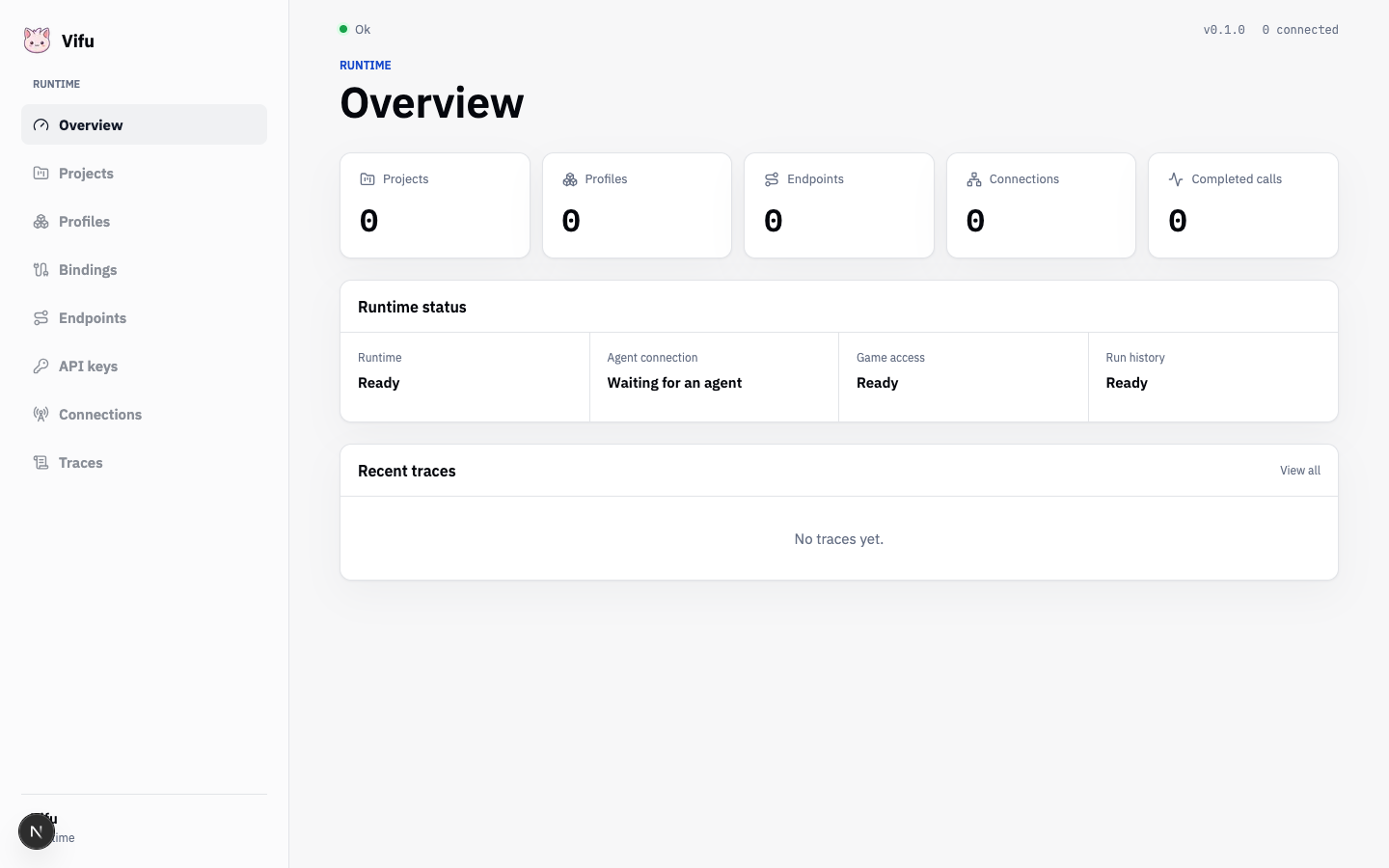
The lightweight Console shows Apps, Agents, providers, API keys, Gateway connections, and traces from the same Vifu deployment.
One core, product-specific behavior
Use an embedded plugin for in-process behavior, a runtime service plugin for an independent backend, or a Gateway integration for an Agent Provider.
Add application behavior as Bevy systems inside the portable Rust runtime.
Connect an application-specific state machine or compiler through the HTTP and JSON-RPC extension contract.
Implement an in-process provider or use Agent Gateway as the remote transport for Vifu Server.
Keep product-specific state, tools, content, and UI outside the reusable runtime core.
Local and self-hosted
Run the Apache-2.0 stack, configure a provider in the Console, create an App key, and make a real request.
Run the Vifu installer to select the current GitHub Release binary for your Mac, Linux, or Windows machine.
Run the vifu binary to start the local Runtime, Agent Gateway, TUI, and embedded Dashboard.
Watch live Agent activity in the TUI and press B to open the same Runtime in the Dashboard.
Connect a provider, call the stable App endpoint, and inspect its trace.